
Industrial facilities depend on proper lubrication to keep equipment operating efficiently and reliably. Bearings, gears, chains, pumps, motors, and other moving components require the correct lubricant in the proper amount to reduce friction and protect against unnecessary wear. While applying lubricant may seem like a straightforward maintenance task, managing lubrication across an entire industrial facility can quickly become complicated.
Different machines may require different oils or greases. Maintenance teams must keep track of application schedules, lubricant quantities, storage conditions, contamination risks, dispensing equipment, and inspection requirements. When these processes are not organized, seemingly minor mistakes can contribute to lubricant waste, equipment wear, and unnecessary downtime.
Lubrication management systems help facilities create a more structured approach to these responsibilities. Rather than treating lubrication as a series of individual maintenance tasks, facilities can coordinate lubricant storage, identification, dispensing, application, monitoring, and documentation as part of a larger reliability strategy.
How do you know when your current approach is no longer enough? Here are five signs that your facility may benefit from improving the way lubrication is managed.
What Are Lubrication Management Systems?
Lubrication management systems bring together the processes, equipment, and procedures used to manage lubricants throughout an industrial facility. This can include everything from how new lubricant is received and stored to how it is identified, filtered, transferred, dispensed, applied, and monitored.
A strong program should make it easy for maintenance personnel to determine which lubricant belongs in each machine, how it should be handled, and when it should be applied. It should also help protect lubricants against contamination before they ever reach critical equipment.
Depending on a facility’s needs, the process may include color-coded storage containers, labeled dispensing equipment, dedicated transfer tools, filtration equipment, automatic lubrication equipment, lubricant sampling, inspection procedures, and maintenance documentation.
The objective is consistency. When employees have clear procedures and the proper equipment, lubrication becomes easier to manage across different machines, departments, and shifts.
1. Your Facility Experiences Frequent Lubrication-Related Equipment Problems
One of the clearest signs of a lubrication problem is repeated equipment trouble.
Bearings that fail prematurely, gears that experience unusual wear, components that regularly overheat, or machines that require frequent lubrication-related repairs may indicate that current practices deserve closer attention.
Lubrication problems are not always caused by the lubricant itself. The correct product can still perform poorly if it is contaminated, applied in the wrong quantity, delivered too late, or accidentally mixed with another lubricant.
Lubrication management systems can help facilities evaluate the entire process instead of addressing each equipment failure individually. Maintenance personnel can examine how products are selected, stored, transferred, and applied to determine where inconsistencies may exist.
For example, if the correct lubricant is being used but contamination repeatedly appears, the problem may originate in storage or transfer practices. If bearings frequently receive too much or too little grease, application procedures may need to be standardized.
Identifying the underlying cause is more effective than repeatedly replacing damaged components without correcting the lubrication issue contributing to the problem.
2. Lubrication Schedules Are Difficult to Manage
Industrial facilities can contain hundreds or even thousands of lubrication points. Each one may have its own lubricant type, quantity, application method, and service interval.
Keeping track of all those requirements can become challenging, particularly when facilities rely heavily on memory, handwritten notes, or informal maintenance routines.
Missed lubrication intervals can leave components without adequate protection. Applying lubricant too frequently can also create problems and increase product consumption. Both situations make it harder to maintain predictable equipment performance.
Lubrication management systems provide a more organized framework for determining what needs attention and when. Maintenance schedules can be coordinated with equipment requirements so technicians have clear guidance rather than relying on assumptions.
Consistency becomes especially important when multiple employees are responsible for lubrication. A standardized process helps ensure that a machine receives similar care regardless of which technician or shift performs the work.
Facilities should also periodically reevaluate their lubrication schedules. Equipment operating conditions can change over time as production demands, loads, temperatures, or operating hours increase. Maintenance intervals that were appropriate several years ago may not always reflect current conditions.
3. Your Facility Uses More Lubricant Than Expected
Higher lubricant consumption does not necessarily mean equipment is receiving better protection.
Unexpected increases in oil or grease usage can indicate leaks, over-lubrication, inefficient dispensing practices, spills, poor inventory control, or other maintenance issues.
Facilities without structured lubricant management may have difficulty determining where products are going. Employees may apply different quantities to the same equipment, containers may be discarded with usable lubricant remaining inside, and spills may occur during manual transfers.
Over time, these small losses can create substantial unnecessary costs.
Lubrication management systems can improve control by standardizing how lubricants are stored, dispensed, and applied. Metered dispensing equipment can help maintenance personnel deliver more accurate quantities, while inventory tracking makes unusual changes in consumption easier to identify.
A sudden increase in lubricant use can also provide useful maintenance information. If a particular machine begins consuming considerably more oil than normal, technicians can investigate whether a leak, damaged seal, or another mechanical issue is responsible.
The goal should not simply be to use less lubricant. The goal is to use the correct lubricant in the correct amount for the application while minimizing unnecessary waste.
4. Contamination and Cross-Contamination Are Ongoing Concerns
Lubricant contamination can begin long before a product reaches machinery.
Dust, dirt, moisture, metal particles, and other contaminants can enter lubricants during storage or transfer. Cross-contamination can also occur when employees use the same pumps, funnels, hoses, or portable containers for incompatible products.
Even new lubricant should be handled carefully. A lubricant can only provide effective protection if it reaches equipment in an appropriate condition.
Facilities experiencing repeated contamination problems should evaluate their complete lubricant handling process.
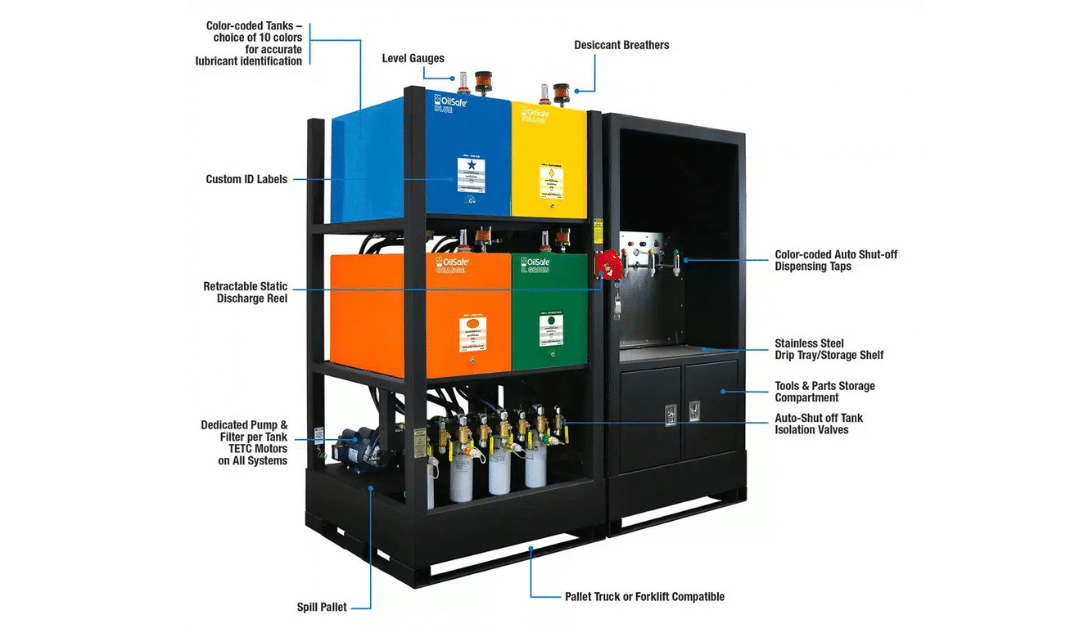
Lubrication management systems can incorporate dedicated storage containers, filtration, dispensing stations, portable transfer equipment, and identification methods that help keep products separated and clean.
Color coding is particularly useful when a facility uses several oils or greases. Matching colors and labels can be applied to storage tanks, transfer equipment, dispensing tools, and machinery so technicians can quickly identify which product belongs where.
New and used lubricants should also remain separate. Mixing used oils, coolants, or other fluids can complicate disposal and recycling while increasing the possibility of contamination.
Cleanliness should continue all the way to the equipment fill point. A well-organized storage room offers limited protection if technicians transfer lubricant into dirty open containers before carrying it to machinery.
5. Maintenance Practices Vary Between Employees or Shifts
Experienced maintenance technicians often develop routines that work well for them. Problems can arise, however, when important lubrication knowledge exists primarily in individual employees’ memories.
One technician may apply a certain quantity of grease while another uses a different amount. Employees may use different transfer containers, follow different inspection procedures, or interpret lubrication schedules differently.
These inconsistencies can become more noticeable as experienced employees retire, new technicians join the team, or maintenance responsibilities shift between departments.
Lubrication management systems establish repeatable procedures that employees can follow regardless of experience level or shift.
Equipment identification, lubricant labels, documented quantities, application intervals, storage procedures, and inspection requirements can all be standardized. Training then reinforces why those procedures matter.
Standardization does not replace the expertise of experienced technicians. Instead, it helps preserve that knowledge and apply it consistently throughout the facility.
This can also simplify onboarding. New maintenance employees have clearer instructions to follow rather than learning every lubrication practice informally.
Better Storage Is an Important Starting Point
A facility cannot build a reliable lubrication program if products are poorly stored.
Lubricants should remain protected from moisture, dust, debris, and other contaminants. Containers should be clearly identified and organized so employees can quickly find the correct product.
PBM Services Company designs and installs turnkey lubricant storage and dispensing solutions that can include dedicated tanks, color coding, labeling, integrated filtration, dispensing stations, and portable transfer units.
For facilities evaluating lubrication management systems, the storage area is therefore an important place to begin. Technicians can assess whether products are properly separated, whether identification is clear, and whether lubricant remains protected throughout transfer.
Improving storage and dispensing procedures can create a strong foundation for the rest of the lubrication program.
Filtration and Cleanliness Matter Too
Keeping lubricant clean is an ongoing process.
Contaminants can enter products during delivery, storage, transfer, or equipment operation. Filtration can therefore play an important role in maintaining lubricant cleanliness.
Facilities should establish cleanliness targets appropriate for their machinery and operating conditions. Filters should be inspected and maintained, while lubricant analysis can help identify contamination or degradation that may not be visible during routine inspections.
PBM provides filtration solutions for removing particulates, water, varnish, and gases from industrial oils, along with lubricant sampling and analysis services that can complement a reliability-centered maintenance program.
Including these practices within lubrication management systems helps facilities move beyond simply adding lubricant according to a schedule. Maintenance teams gain additional information that can help them evaluate lubricant and equipment condition.
Automatic Lubrication Can Improve Consistency
Some industrial applications can also benefit from automatic lubrication.
Rather than requiring technicians to manually reach every lubrication point, properly designed automatic equipment can deliver lubricant according to the needs of the machinery. This can be particularly valuable for equipment with numerous points, difficult access, or demanding operating schedules.
PBM designs, builds, installs, evaluates, updates, and repairs automated lubrication equipment. Its evaluation process considers the asset, lubricant properties, and operating concerns before recommendations are made.
Automation does not eliminate the need for inspection or maintenance. Pumps, controllers, injectors, distribution blocks, lines, and other components still need attention.
When used appropriately, however, automatic equipment can become another part of comprehensive lubrication management systems by helping improve application consistency.
Documentation Makes Lubrication Easier to Evaluate
Maintenance teams cannot improve what they cannot track.
Documentation provides a record of which lubricants are being used, when applications occur, how much product is consumed, and what equipment problems are being discovered.
Records can also reveal trends. A machine that suddenly begins consuming more lubricant may deserve inspection. A component experiencing repeated failures may require a different lubrication approach or additional investigation.
Lubricant analysis results, equipment inspections, repairs, and system modifications can also be documented alongside lubrication activities.
Over time, this information helps maintenance teams make decisions based on equipment history rather than assumptions.
Do Not Overlook Employee Training
Even sophisticated equipment cannot compensate for inconsistent handling practices.
Employees should understand how lubricants are identified, where they are stored, which transfer tools belong to each product, how contamination should be prevented, and how unusual equipment conditions should be reported.
Training should also explain why the procedures matter. When employees understand how a dirty transfer container or incorrect grease can affect expensive machinery, proper handling becomes more than simply another maintenance rule.
Periodic refresher training can help maintain consistency as equipment, products, and employees change.
Start With an Evaluation of Current Practices
Facilities do not necessarily need to replace every storage container or automate every lubrication point at once.
A better starting point is evaluating existing practices and identifying the areas creating the greatest risk or inefficiency.
PBM’s inspection services examine lubricant performance, lubrication-system health, and equipment operating conditions, followed by reports and recommendations based on the findings.
An evaluation may reveal relatively straightforward opportunities, such as improving labeling, separating transfer equipment, changing filtration practices, adjusting application quantities, or updating a lubrication system.
The right improvements depend on the machinery, lubricants, operating environment, and maintenance challenges within the individual facility.
Building a More Reliable Lubrication Program
Effective lubrication is not a single maintenance task. It is a process that begins when lubricant enters the facility and continues through storage, filtration, dispensing, application, monitoring, and eventual disposal.
Lubrication management systems bring these individual activities together so they can be managed more consistently.
For industrial facilities, the benefits can extend beyond lubricant organization. Better practices can help reduce contamination, control unnecessary lubricant consumption, improve maintenance consistency, and support the long-term reliability of critical equipment.
The most effective programs also evolve. Maintenance teams should periodically review equipment performance, lubricant consumption, contamination levels, inspection findings, and employee procedures to determine whether adjustments are necessary.
Providing a Framework
Frequent equipment problems, difficult maintenance schedules, excessive lubricant consumption, contamination, and inconsistent employee practices can all indicate that a facility’s current lubrication approach needs improvement.
Rather than addressing these issues individually, lubrication management systems provide a framework for coordinating the entire process. Proper storage, identification, dispensing, filtration, application, monitoring, documentation, and training can work together to create a more dependable maintenance program.
For facilities looking to improve equipment reliability, evaluating current lubrication practices can reveal where greater consistency, cleanliness, and organization may provide the most value.
Stay up to date with the latest at PBM Services Company by following us on LinkedIn.